
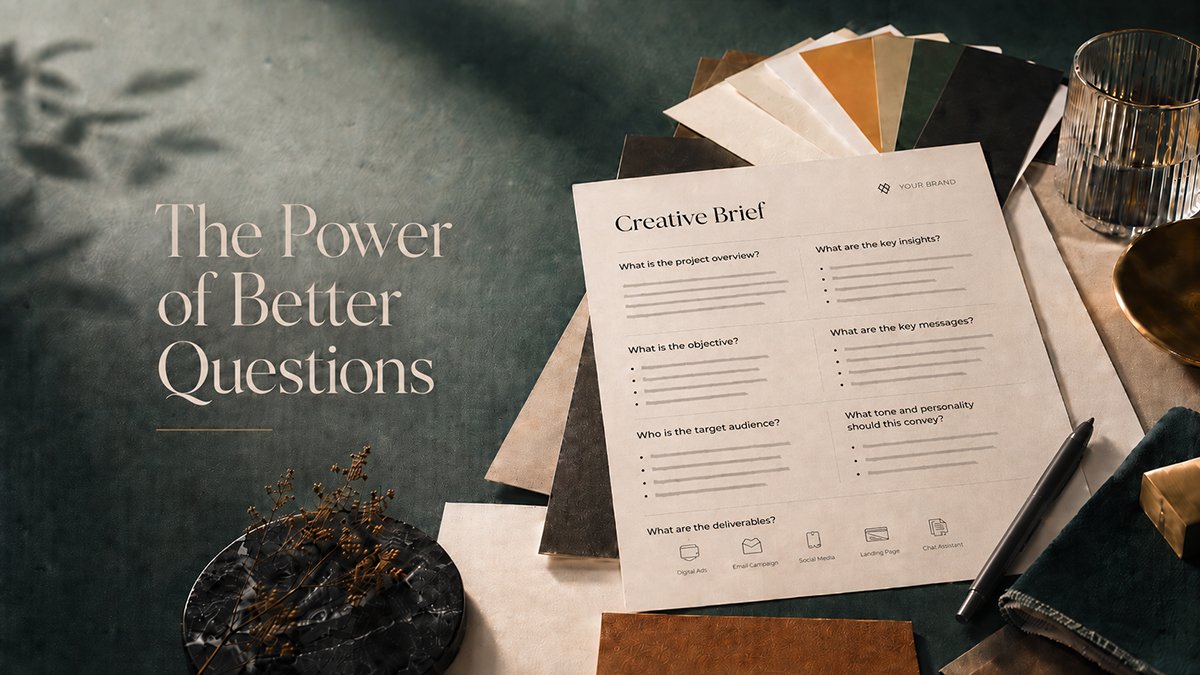
How to Build Powerful Creative Briefs
Most businesses don't have a creative problem. They have a briefing problem. It's tempting to believe that creativity begins with ideas. It doesn't. It begins with questions.
Adopt the briefing process that changes everything
Most businesses don't have a creative problem. They have a briefing problem. It's tempting to believe that creativity begins with ideas. It doesn't. It begins with questions.
When the brief, also known as a creative brief, is vague, the work becomes subjective. Projects drift. Revisions multiply. Budgets disappear. And somewhere along the way, everyone forgets what success was supposed to look like. So many businesses skip the creative brief believing it is unnecessary. The creative brief is the harness that provides an objective, timelines and a sense of responsibility. Therefore, it becomes easier to understand project performance and ultimately, ROI.
Every Great Solution Starts by Defining the Right Problem
Clients often ask for a new logo, a new website, a brochure, or a marketing campaign. Those may be the right solutions. They may also be the wrong questions: A website won't fix an unclear value proposition. A new logo won't solve declining customer loyalty. More advertising won't help if customers don't understand why they should choose you in the first place. Before deciding what to create, it's worth asking whether we're solving the right problem, and whether we are creating the right tools to solve it..
Ask the Questions that Matter
Before a single concept is explored, I want to understand the business behind the project.
Questions like:
What business objective are we trying to achieve?
How does this project fit into the overall strategy of the business?
Who are we speaking to and what action do we want them to take?
What barriers prevent this audience from taking action?
What are the markers of success for this project?
Why does this project matter now and now does it fit into the overall vision?
The answers rarely fit inside a traditional creative brief. But they almost always determine whether the work succeeds.
Creativity without Strategy is Decoration
Good design attracts attention, but good strategy gives people a reason to care. When creative decisions are guided by a clear understanding of the customer and the business, the work becomes more focused, more persuasive, and far more effective. All the choices such as colour, texture, content become obvious. Even the simplest decisions become clearer because they're anchored to outcomes rather than preference.
Collaboration Beats Assumption
The best briefs aren't written in isolation, they're built through conversation. Owners, leadership teams, staff, customers, and stakeholders often see different parts of the same challenge. Bringing those perspectives together reveals opportunities that no questionnaire ever could.
Listening isn't simply part of the process. It is the process—The information gathered informs the direction of the brief.
The Brief Is More Than a Document
A good brief gives creativity direction. It creates alignment before design begins. It reduces unnecessary revisions. It saves time. It protects budgets. Most importantly, it keeps everyone working toward the same business outcome.
Better Questions. Better Decisions. Better Business
Every successful project I've worked on—whether in healthcare technology, retail, publishing, tourism, or e-commerce—has shared one thing in common. The conversation before the work was every bit as important as the work itself. That's why I never begin with software. Or sketches. Or presentations. I begin with questions. Because the quality of the answers will almost always determine the quality of everything that follows.